How are Saturating Removal (SR, Uri Alon et al.) and Minimal Aging model (Fedichev & Gruber) related?
I recently read the following paper by Uri Alon and his group:
https://doi.org/10.64898/2025.12.22.695887
It's a great paper! They study their own aging model (Saturating Removal) as to how different parameters affect healthspan and lifespan. In addition, they also do a similar analysis for the Minimal Aging model by Peter Fedichev and Jan Gruber. The nice thing about the paper is that they are very thorough in documenting how they compute things and give explicit values for the model parameters after fitting them to a dataset or when presenting figures. Very nice!
Further, the paper has a set of supplemental material, which covers some of the analytical properties of both models.
Reading this paper deepened a notion I already had before. Namely that both models seem to be very similar. In this little article I want to investigate how similar they actually are.
1. Errata
- : a previous version missed the prefactor in the mapping in sec. Allow constant offset in SR model.
2. Mathematical definition of both models
Let's first remind ourselves of the definition of both aging models.
Note: Parameters that appear in both models with the same letter, will have a suffix or to indicate their origin.
2.1. SR model
The SR model is described by the following differential equation,
\[ \frac{dX}{dt} = ηt - β_{\text{SR}} \frac{X}{X + κ} + \sqrt{2ε}ξ(t), \]
where "are model parameters, while represents Gaussian white noise. η has units of time⁻², of time⁻¹, of time⁻¹, is normalized to 1, and and are in units of ." (from the supp. mat.). Note that "is normalized to 1" means that it is a dimensionless constant, not that its value is exactly 1 (in practice it typically seems to be ).
In the model, is the damage accumulation parameter. It is linear in time, which means the damage accumulation rate increases linearly with time. This is a modeling of the aging process, in which the large number of failing subsystems result in ever more damage appearing at faster rates.
is the maximum removal capacity of damage (hence the negative sign of the term). At small values, the term is effectively , which means the removal rate is proportional to the existing damage (i.e. fast healing rates etc.). At large values, , which means a fixed damage removal rate of . is the amount of damage at which the relative removal rate is half that of the total removal capacity and thus represents an important point at which the nonlinear saturation property starts to become important. Note that this is early in life / at very low total damage values. A typical death threshold is , while is often .
The last term with parameter is the Gaussian noise the system is under at all times.
2.2. F&G model
In contrast, the Fedichev & Gruber model is defined by
\begin{align} \frac{dz_0}{dt} &= β_{\text{FG}}Z(t) - (ε_0 - β'Z(t)) z_0 + gz²_0 + J_0 + \sqrt{2D_0} ξ \\ \frac{dZ}{dt} &= γ \end{align}The fast variable represents a reversible “resilience” or leading physiological state of the organism. The slow variable \(Z(t) = γ t + Z_0\) is the irreversible accumulation of entropic damage, where is the damage accumulation rate (DAR).
The parameters are interpreted as follows: couples damage production to the slow damage level, is the baseline linear restoring force that pulls back toward equilibrium, quantifies how accumulating damage gradually erodes this resilience, is the strength of the quadratic destabilizing nonlinearity, is an optional constant external stress, and sets the amplitude of Gaussian noise.
Note that the second equation has a simple solution. It is solved by
\[ Z(t) = γt + Z_0 \]
where is some initial damage.
If we insert this into the first differential equation, we get the following form,
\begin{align} \label{eq:fg_expanded} \frac{dz_0}{dt} &= β_{\text{FG}}(γt + Z_0) - (ε_0 - β'(γt + Z_0)) z_0 + gz²_0 + J_0 + \sqrt{2D_0} ξ \\ &= β_{\text{FG}}γt + β_{\text{FG}}Z_0 - (ε_0 - β'γt - β'Z_0) z_0 + gz²_0 + J_0 + \sqrt{2D_0} ξ \\ &= (β_{\text{FG}} + β'z_0) γt + β_{\text{FG}}Z_0 - (ε_0 - β'Z_0) z_0 + gz²_0 + J_0 + \sqrt{2D_0} ξ. \\ \end{align}In the second equation I've grouped everything by powers of and in the last equation by terms based on .
Importantly, death in the F&G model is not defined by a hard threshold on (in contrast to SR’s ). Instead, death occurs via loss of dynamical stability: as increases, the effective restoring force weakens until a saddle-node bifurcation is reached (the stable fixed point disappears). Mortality then arises from stochastic escape over the flattening potential barrier. This stability-based death criterion is a direct mathematical consequence of the quadratic truncation, as we will see in sec. 11.
3. Generic Langevin potential differential equation
Both models represent a differential equation for a particle in a potential well, undergoing stochastic random noise and are a Langevin equation.
In a generic sense, we can write
\begin{equation} \label{eq:generic_langevin} \frac{d x}{d t} = A t + B - C x + G x² + \sqrt{2 D} ξ(t), \end{equation}where we have a direct time dependence with coefficient , a constant coefficient , a negative linear term in , a quadratic term in and the stochastic random noise term with coefficient , where I have written the time dependence of the random process explicitly. The latter is what makes this a stochastic differential equation (and the omission of the explicit time dependence in both papers is imo annoying).
When comparing the two models above with this equation, we can see that they sort of follow this equation, but not quite:
- the SR model does not seem to have the terms ,
- the F&G model has a term in addition, which would correspond to something like in our notation here (with a new parameter ).
In the next few sections we will show that these differences are to a large extent cosmetic.
4. SR model: linear and quadratic terms
The form presented in eq. \eqref{eq:generic_langevin} does not seem to show up in the SR model. The equivalent of the variable in the SR model is the variable. contains all terms that are proportional to in some sense. Thus, the corresponding term in SR, is
\[ -β_{\text{SR}}\frac{X}{X + κ}. \]
Now, if you are a physicist like me or someone with more applied math experience, you will probably realize that these two are more similar than they appear at a first glance. Consider this:
- at very small values where , the fraction behaves like a linear (!) function
- at slightly larger values the value of becomes more important. This slows the growth of the linear curve. This can be modeled by a negative quadratic term.
To make this more concrete, we can do the Taylor expansion 1 of this fraction around ,
\[ \frac{X}{X + κ} = \frac{X}{κ} - \frac{X²}{κ²} + \frac{X³}{κ³} - \frac{X⁴}{κ⁴} + \mathcal{O}(X⁵). \]
If we ignore all terms of or higher, this is exactly the form of the generic Langevin equation.
Applying this to the SR model as a whole yields the following,
\begin{equation} \label{eq:sr_model_taylor} \frac{dX}{dt} = ηt - β_{\text{SR}} \frac{X}{κ} + β_{\text{SR}}\frac{X²}{κ²} + \sqrt{2ε}ξ. \end{equation}This is eq. \eqref{eq:generic_langevin} with
\begin{align} A &= η & B &= 0 & C &= \frac{β_{\text{SR}}}{κ} \\ G &= \frac{β_{\text{SR}}}{κ²} & D &= ε & & \end{align}Later in sec. 11 we will discuss the validity of this Taylor expansion in more detail. In particular how it relates to the F&G model, the death criteria and the death threshold in SR.
5. F&G model: an additional term
The F&G model in expanded form eq. \eqref{eq:fg_expanded} is,
\[ \frac{d z_0}{dt} = β_{\text{FG}}γt + β_{\text{FG}}Z_0 + J_0 - (ε_0 - β'Z_0) z_0 + gz²_0 + β'γt z_0 + \sqrt{2D_0} ξ \]
This lets us identify the equivalent coefficients compared to the generic Langevin equation \eqref{eq:generic_langevin} as,
\begin{align} A &= β_{\text{FG}}γ & B &= β_{\text{FG}}Z_0 + J_0 & C &= ε_0 - β'Z_0 \\ G &= g & D &= D_0 & & \end{align}which only leaves us with one mismatched term. The term is a direct coupling between the time and position variables.
This leaves us with the initial conclusion of restricting us to the case of . With that restriction the F&G model reduces to,
\begin{equation} \label{eq:fg_beta_zero} \frac{d z_0}{dt} = β_{\text{FG}}γt + β_{\text{FG}}Z_0 + J_0 - ε_0 z_0 + gz²_0 + \sqrt{2D_0} ξ \end{equation}6. Preliminary comparison of SR and F&G model
Now compare the Taylor expanded version of the SR model, eq. \eqref{eq:sr_model_taylor} with the F&G variant without explicit time coupling, eq. \eqref{eq:fg_beta_zero}. We can then conclude the two models are equivalent if and only if,
\begin{align} η &= β_{\text{FG}}γ & Z_0 &= J_0 = 0 & β_{\text{SR}} &= ε_0 \\ \frac{β_{\text{SR}}}{κ²} &= g & ε &= D_{0} & & \end{align}In other words, if we accept zero starting entropy and no constant stress in the F&G model and restrict the parameter space of to (and thus reducing a degree of freedom as and are coupled via the parameter), the two models are identical for small .
7. Allow constant offset in SR model
In order to relax the restriction that to obtain the same model as SR, we can make a minor extension to the SR model.
Namely, by performing a time shift \(t ↦ t + τ\), we gain an additional parameter, which can capture the constants. In general terms, the differential equation is,
\[ \frac{dX}{dt} = f(t, X(t)), \]
where is the placeholder for the exact definition, which is solved by . If we define a new solution,
\[ Y(t) \coloneq X(t + τ), \]
we arrive at,
\[ \frac{dY}{dt} = \frac{d}{dt} X(t + τ) = f(t + τ, X(t + τ)) = f(t + τ, Y(t)). \]
That means, the time shifted equation with \(t ↦ t + τ\) is solved by . Writing out this equation explicitly in our case,
\begin{equation} \label{eq:sr_time_shifted} \frac{dX}{dt} = η(t + τ) - β \frac{X}{κ} + β\frac{X²}{κ²} + \sqrt{2ε}ξ. \end{equation}At this point the term corresponds to the constant offset. This time shifted version of the SR model can thus be mapped to the F&G model via either,
- ,
- or
depending on preference or purpose.
8. Mapping F&G to SR
At this point we can map the F&G model to the SR model in an almost general fashion (with the only limitation still being ).
If we map the coefficients of eq. \eqref{eq:generic_langevin} from the SR model with constant offset and the F&G model and solve them for the SR parameters, we arrive at the following mapping:
\begin{align} \label{eq:mapping_fg_sr} η &= β_{\text{FG}}γ & β_{\text{SR}} &= \frac{ε_0²}{g} \\ τ &= \frac{1}{γ}\left( Z_0 + \frac{J_0}{β_{\text{FG}}}\right) & κ &= \frac{ε_0}{g} \\ ε &= D_0 & & \end{align}This allows to map any specific instantiation of the F&G model to an equivalent SR model.
Note that the parameter, is independent of . This makes a lot of sense, as the new time parameter is just an offset of "starting damage" / "initial entropy". It does not depend on how damage accumulates over time or generally the system evolves.
9. Finally: introduce time-position coupling in SR model
We have now seen that with some minor modifications to the SR model, the two are almost identical. The one mismatch is the existence of the parameter in the F&G model, which couples its variable to its variable. We may wish to recover the lost degree of freedom from setting in the F&G model.
By taking to be in the SR model in addition to the previous modifications, we can then also recover the coupling of time and position. In the simplest form we may take,
\[ β(t) = β_0 + β_1 t \]
We now plug this into our time shifted variant of the SR model, eq. \eqref{eq:sr_time_shifted}.
\begin{align} \frac{dX}{dt} &= η(t + τ) - β(t) \frac{X}{κ} + β(t)\frac{X²}{κ²} + \sqrt{2ε}ξ \\ &= η(t + τ) - β_0 \frac{X}{κ} + β_0 \frac{X²}{κ²} - β_1 t \frac{X}{κ} + β_1 t \frac{X²}{κ²} + \sqrt{2ε}ξ \end{align}If we map to the normal we had before we now have two additional terms, . The former is the equivalent of the term in the F&G model. We are justified in ignoring the latter term, as the product is of a higher order than the terms we decided to include after our Taylor expansion, which we cut off at . This means our final model is,
\begin{equation} \frac{dX}{dt} = η(t + τ) - β_0 \frac{X}{κ} + β_0 \frac{X²}{κ²} - β_1 t \frac{X}{κ} + \sqrt{2ε}ξ \end{equation}10. Fully generic Langevin equation including time coupling
If we include a time position coupling into the general Langevin equation \eqref{eq:generic_langevin} from above, we arrive at this equation with added parameter :
\begin{equation} \label{eq:generic_langevin_with_time} \frac{d x}{d t} = A t + T t x + B - C x + G x² + \sqrt{2 D} ξ(t). \end{equation}We can use this to map both the F&G model and SR model to these now six parameters.
It leads to the following expressions, which while appearing slightly more complicated are a logical extension of the mapping in sec. Mapping F&G to SR, eq. \eqref{eq:mapping_fg_sr}:
\begin{align} \label{eq:full_mapping_fg_sr} η &= β_{\text{FG}}γ & β_{\text{SR}} &= \frac{(ε_0 - β'Z_0)²}{g} \\ τ &= \frac{1}{γ}\left( Z_0 + \frac{J_0}{β_{\text{FG}}}\right) & κ &= \frac{(ε_0 - β' Z_0)}{g} \\ ε &= D_0 & β_1 &= -\frac{ε_0 - β' Z_0}{g} β' γ \end{align}Essentially, we need to replace by and we have an additional equation for the new parameter .
This is our final parameter mapping. This is an almost fully general mapping between the SR and F&G models, including all parameters of the F&G model. This mapping maps all eight parameters of the F&G model to the now six parameters of the SR model.
11. Validity range of the Taylor approximation and implications for the two models
Having discussed the mapping of our modified SR model to the F&G model, let's now come back to one of the biggest modifications / assumptions we made: the Taylor expansion of the term in the SR model. As mentioned previously, this Taylor expansion is valid for small values of , because we expanded around \(X = 0\). Small here is relative to the magnitude of , which tends to be at . However, the SR model defines death as the damage crossing the critical damage threshold . Those kind of damage values are well outside the validity range of the Taylor expansion.
Fig. 1 compares the relative damage removal rate of the actual term with the first three orders of the Taylor expansion, linear , quadratic and additionally cubic . We can see that for values up to around the three expansions are roughly compatible. However, beyond that they start to diverge rapidly with the linear and cubic terms exploding, indicating the damage removal keeping up with the damage, while the quadratic term actually goes back down to zero (and technically towards ).
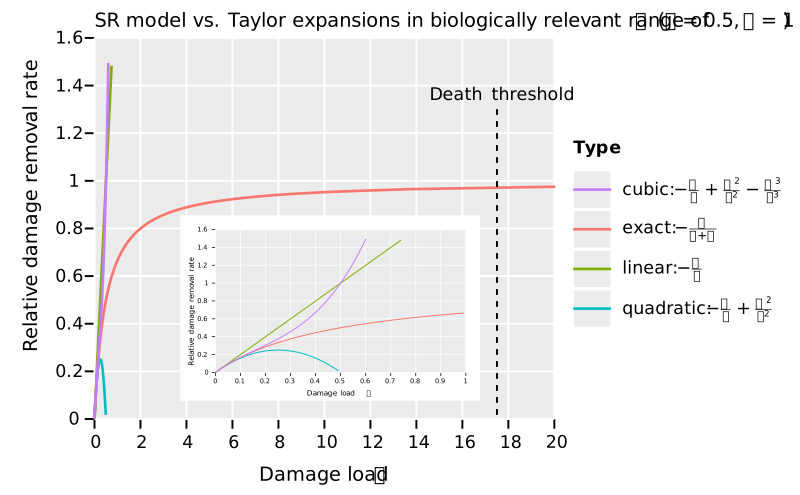
This limited validity range directly explains several apparent differences between the two models and highlights their complementary strengths.
Crucially, the SR model yields sensible results that reproduce biological systems up to large damage values. In contrast, a model like F&G or our modified SR model does not behave sensibly at large damage values. SR thus has more robust global behavior.
While this may appear to point to an enormous problem in our mapping between the models, the (in my opinion) correct interpretation is a lot more interesting. The fact that the Taylor expanded version is not sensible for large values of implies the F&G model must use a different definition of death out of necessity. So while the two models can look very similar at the level of the differential equation, their actual application to an 'agent simulation' is inherently different.
12. Summary & conclusion
Effectively, the SR and F&G models are similar models, with some different choices driven by their different definitions. Viewing the F&G model as a local approximation of the SR model explains why the F&G model cannot have a global damage threshold as the definition for death. At the same time, the F&G model in practice contains more independent parameters and includes constant offsets.
The functional definition of SR's differential equation contains F&G as a local, small-approximation. The additional parameters that F&G exposes can only be modeled after mild modification (time shift, time dependent ).
Footnotes:
A Taylor expansion of a function is a representation of said function around a specific point via an infinite series of polynomials. In physics it is very often used to reduce a complex expression to simpler, lower order terms that are accurate for small values, by cutting off the expansion at a fixed order.